Preparing for Carpet Weaving
Before beginning the weaving process, the weaver must consider the size of the future carpet, the density of the knots, the nature of the patterns and overall composition, as well as many other factors. During weaving, the structure of the carpet takes shape, and the carpet is created on the loom through the sequential interlacing of weft and knot threads. Today, different types of looms are used for the production of various kinds of carpets.
The Beater (Kirkit)
The kirkit is a tool used to tighten and secure the knots while weaving a carpet. In some regions of Azerbaijan, this tool is known as a “comb.” In earlier times, the kirkit was made of wood or horn. It typically had two, three, or four teeth. Over time, like other traditional tools, the kirkit was improved and metal tips were added to its teeth. Since earlier versions did not fully meet technological requirements, kirkit tools began to be produced entirely from metal, giving rise to the modern kirkit.
Carpet-Weaving Scissors
In the early stages of carpet weaving, scissors were not used. Later, ordinary household scissors began to be used to smooth the pile surface of the carpet. Although these simple scissors improved the quality of the carpet to some extent, they restricted the free movement of the fingers and made weaving more difficult. Such scissors could slightly reduce the overall quality of the carpet.
The Carpet-Weaving Knife
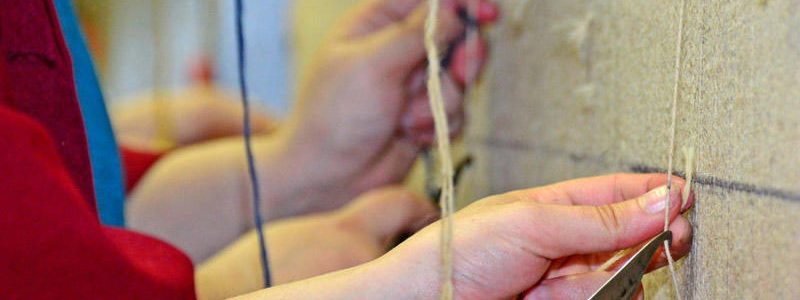
For a long time, simple blacksmith-made knives were used for cutting the thread during weaving. In rural areas, these knives were often crafted from old sickles. The modern weaving knife—which began to be used in the early 19th century—consists of a hook, a cutting blade, and a handle. This knife is also used to fix mistakes, open knots, and tie them again. The modern carpet-weaving knife catches the thread with its hook, ties the knot, and cuts the yarn.