Ancient Period
Archaeological excavations carried out in Azerbaijan date back to the 6th century BC. These findings prove that as early as the 2nd millennium BC, agriculture, animal husbandry, metallurgy, pottery, and carpet weaving were highly developed in this region. The oldest known carpet in the world is the famous Pazyryk carpet, discovered during archaeological excavations in the Altai Mountains dating to the 6th–5th centuries BC. Excavations in Gultəpə, located within the territory of Azerbaijan, have revealed traces of tools and dyes used in carpet weaving from the 4th–3rd centuries BC.
Carpet Weaving as a Folk Art
Carpet weaving is one of the oldest and most popular forms of folk art in Azerbaijan. This craft has a very ancient history. Archaeological excavations in the territory of modern Iran (Maku, Lake Urmia) revealed cloths decorated with various animal figures, proving the antiquity of this art. In excavations carried out in Mingachevir, palace remains, fragments of carpets, and weaving tools were discovered in catacomb graves dating from the 3rd–8th centuries AD.
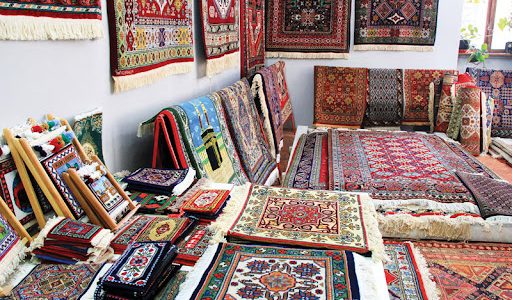
Azerbaijani carpets are classified into different groups based on geographical regions, motifs, compositions, color palettes, and technical characteristics. The carpets are often named after the regions where they were woven. Traditionally, Azerbaijani carpet weaving is divided into seven schools: Quba, Baku, Ganja, Karabakh, Tabriz, Shirvan, and Gazakh.
The Social Role of Carpets
Carpets united people, inspiring a sense of community, mutual assistance, and friendship. The Azerbaijani carpet was not merely a practical household item—it carried a deeper meaning. It was both an essential element of the national lifestyle and a distinct form of decorative-applied art. The moral and ethical values of the people were closely connected to carpet art.
Historical Development
Based on archaeological evidence and written sources, carpet weaving in Azerbaijan emerged during the Bronze Age—approximately 5,000 years ago. Azerbaijani carpets reflect the vibrant nature of the country: the blue of the sky, the green of the forests, the colors of the mountain slopes, and the white peaks covered with snow. The delicate red of pomegranate seeds, golden animal figures, yellow saffron, and amber grapes blend magnificently in these carpets.
Azerbaijani carpets are distinguished by their rich dyes, unique combinations of motifs, creative imagination, and superior craftsmanship. Historical sources indicate that during the Middle Ages, Azerbaijan was one of the major centers of both pile and flat-woven carpet production in the East. The 10th-century manuscript Hudud al-Alam notes that Azerbaijani cities, including Mughan, were famous for their bags and palace textiles; Nakhchivan, Khoy, and Salmas were renowned for their bells, carpets, and woven products; and Ardabil and Shirvan were celebrated for their colorful silk and wool fabrics.
Azerbaijani Carpets Around the World
Beautiful carpets and carpet products created by Azerbaijani women adorn some of the world’s greatest museums: the Hermitage Museum in St. Petersburg, the Victoria and Albert Museum in London, the Textile Museum in Washington, the Louvre in Paris, the Topkapi Palace in Istanbul, as well as the Azerbaijan Carpet Museum and the National Museum of History in Baku.
Unfortunately, in recent times, Azerbaijani carpets are sometimes displayed in world museums under labels such as “Caucasian,” “Persian,” or “Armenian” carpets. However, carpet weaving belongs to nations with a deep cultural heritage and ancient artistic traditions.
Carpet-Weaving Schools
The Azerbaijani carpet-weaving schools—Quba-Shirvan, Ganja-Gazakh, Karabakh, and Tabriz—are renowned worldwide. The carpets woven in these regions stand out for the density of their knots, richness of color shades, quality of pile, weaving techniques, and motifs.
Ganja carpets possess a unique style with a variety of color tones. Known by the name of the Karabakh horses, these carpets were exported abroad, earned high awards at exhibitions, and were presented as precious gifts to guests. The rich and colorful nature of the western regions played an invaluable role in the development of carpet weaving.
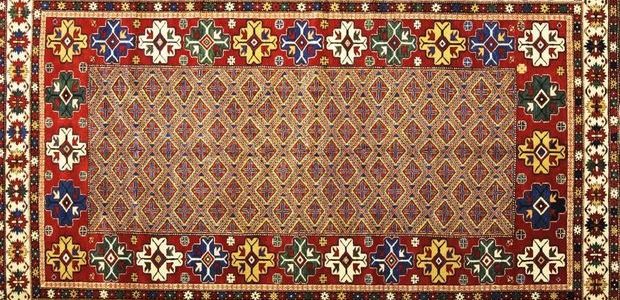
One of the distinguishing features of Ganja carpets is the use of natural raw materials and dyes. The carpets of the Ganja-Gazakh region are primarily woven from wool, which gives them a relatively loose knot structure, thick pile, and predominantly geometric patterns. Their standard size is about 3 square meters, typically 1.5 × 2 (2.5) meters. These carpets usually incorporate 5–7 colors, with blue, tulip red, and floral red being the dominant shades. Since silk production once flourished in Ganja, silk carpets were also woven here.